

Start with what the cards on a piece actually show. Four aces repeat one rank across four suits. A royal flush is a complete five-card sequence in one suit. A single spade puts the focus on one suit symbol, and on the pendant below, that symbol belongs to a specific card: the Ace of Spades. Once you know which of those you want, choose the format: a band that carries the cards around the finger, a ring face that gathers them on top, or a pendant that hangs at the neck.
Rank, suit and hand: reading the motif
A card's rank is its value: ace, king, queen, jack, ten and so on down. Its suit is the symbol it belongs to: spades, hearts, diamonds or clubs. In five-card poker rankings, a hand combines five cards, and its name describes how those ranks and suits combine. Casino rules set out the definitions; see, for example, the hand rankings in The Star Sydney's Ultimate Texas Hold'em rules.
- Four aces is a repeated rank. The same value appears once in each suit. In poker, four of a kind still needs a fifth card to make a hand, so a four-ace motif is a set of four cards, not a complete hand.
- A royal flush is ace, king, queen, jack and ten, all in the same suit. It is a complete five-card hand; the ring below shows it in spades.
- A single spade is a suit motif. On its own it names no particular card. Paired with A markings, as on the pendant here, it becomes one specific card, the Ace of Spades.
Choose the motif for the cards it shows, its graphic shape or a personal association. Treat it as a design choice rather than a promise of luck.
Four pieces compared
All four are listed as .925 sterling silver. Read the measurement label before comparing numbers: band width, the decorated face of a ring and a pendant's listed dimensions describe different things. None is a finger-size measurement.
| Piece and format | Card composition | Listed measurement | Item weight |
|---|---|---|---|
| Four Aces Band ring |
Four aces, one in each suit | Band width: approx. 11 mm | Approx. 7 g |
| Royal Flush of Spades Ring |
A, K, Q, J and 10 of spades | Face: approx. 0.8 × 0.8 in (20.3 × 20.3 mm) | Approx. 22 g |
| Ace of Spades Card pendant |
One Ace of Spades | Pendant: approx. 7/8 × 1½ in (22.2 × 38.1 mm) | 12 g |
| Ace of Spades Skeleton Hand Ring |
One Ace held by skeletal fingers | Face: approx. 23 × 27 mm | Approx. 30 g |
The weights are listed item weights, not measurements of fine-silver content or tests of how each piece feels when worn.
Repeated rank or a full hand: the two multi-card rings
The Sterling Silver Four Aces Poker Ring spreads its cards around the band. Rectangular ace panels sit on a flat, polished band with smooth edges, and darkened recesses pick out the letters and pips. There are no stones. At about 11 mm wide and about 7 g, it has the lowest listed weight of the four. A hallmark sits inside the band.
The Royal Flush of Spades Sterling Silver Ring takes the opposite approach. Instead of spacing cards around the finger, it fans all five, A, K, Q, J and 10, across one face of about 0.8 × 0.8 in (approximately 20.3 × 20.3 mm). Dark spade pips mark every card in the same suit, and patterned shoulders carry the texture down the sides. Its listed weight is about 22 g.
The choice comes down to arrangement. The band spreads the ace panels around the finger. The royal flush gathers a complete hand into a single focal face. Neither listing gives a ring height or thickness, so compare profiles in the product photos; our gothic ring styles guide explains how face, width and profile change a ring's look.
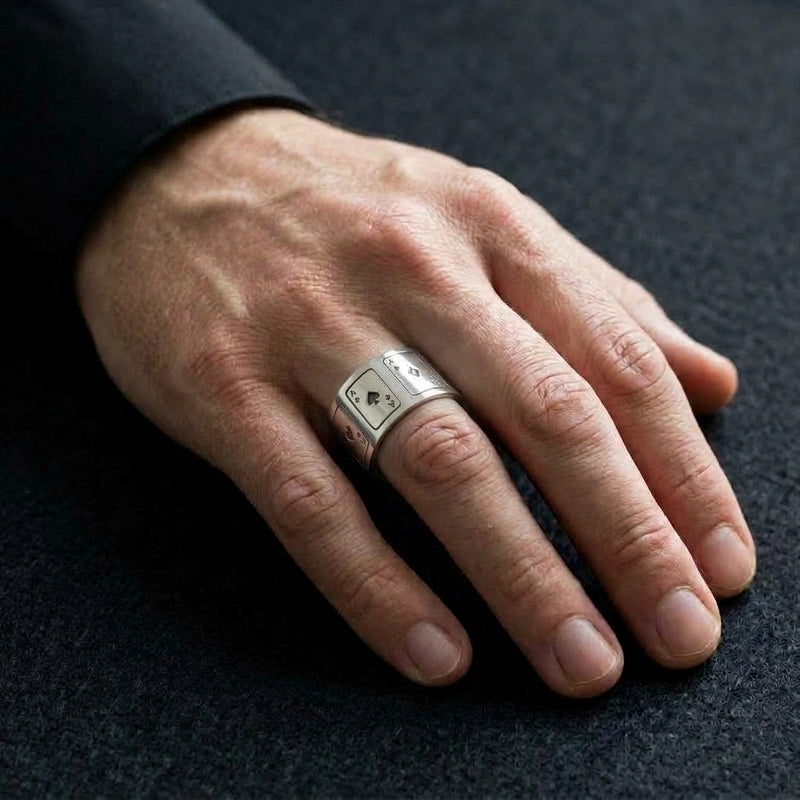
Sterling Silver Four Aces Poker Ring
Four aces set around an 11 mm band, with the lowest listed weight here at about 7 g.
Choose your size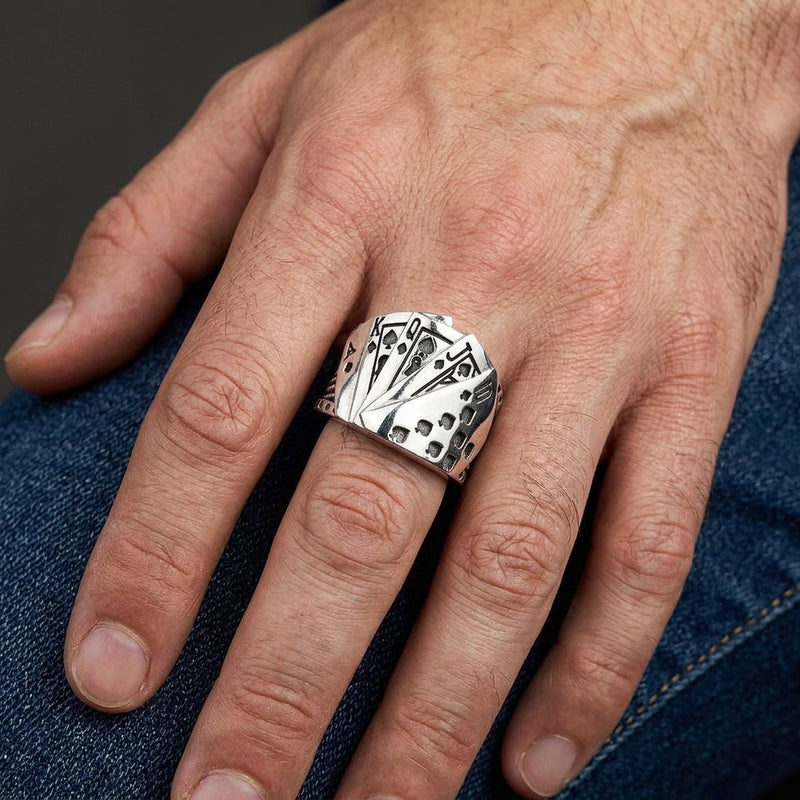
Royal Flush of Spades Sterling Silver Ring
A complete royal flush of spades fanned across one face of about 0.8 × 0.8 in.
Choose your sizeOne card: the Ace pendant or the skeleton-hand ring
If a single card is enough, the format becomes the main decision.
The Ace of Spades Sterling Silver Card Pendant is a curved rectangle of about 7/8 × 1½ in (approximately 22.2 × 38.1 mm), listed at 12 g. A large raised, polished spade sits over a dark textured center, with ornamental scrollwork and A markings at opposing corners. The bail is cut in a spade shape, and the reverse carries a lattice pattern with a 925 mark. The pendant is sold on its own; a chain or cord is not included. The listing doesn't state the bail's inside opening, so check your chain's end fittings with our pendant chain fit guide before relying on a chain you already own.

The Ace of Spades Skeleton Hand Sterling Silver Ring puts a single card on the finger and adds sculpture. Sculpted silver skeletal fingers hold one Ace of Spades card at its edge, with black spade details and dark joints against the polished card face. The face measures about 23 × 27 mm and the ring is listed at about 30 g, the highest listed item weight in this comparison. A .925 mark sits inside the band.
The pendant keeps the card shape on its own and moves it to the neck, on a chain you choose. The skeleton-hand ring pairs the Ace with a skeletal motif and keeps it on your hand, where you see it yourself.

Ace of Spades Sterling Silver Card Pendant
A single Ace of Spades card of about 7/8 × 1½ in, sold without a chain.
View details
Ace of Spades Skeleton Hand Sterling Silver Ring
One Ace of Spades held by sculpted skeletal fingers on a 23 × 27 mm face.
Choose your sizeMaking the choice
Decide on the cards first, then the format. If repeated rank is the point, the four-aces band shows it without claiming a full hand. If you want a complete hand, the royal flush is the only five-card design here. If one specific card is enough, the Ace of Spades comes as a pendant for the neck or as a sculpted ring for the hand. For a ring, select your size from the options available on its product page.
If you prefer a ring, compare more designs in the rings collection.

