

A raven skull necklace can be a personal reference to literature, an interest in bird forms or simply a design you enjoy. Its name alone does not assign a meaning to everyone who wears it. If you connect it to Edgar Allan Poe, the useful question is which part of the poem matters to you—and how that connection differs from what the pendant actually shows.
What Poe’s raven actually does
Edgar Allan Poe’s poem “The Raven” was published in 1845, and the full 1849 text at the Poe Society of Baltimore is worth reading start to finish. A narrator mourning his lost Lenore is visited by a living, feathered raven, which perches on a bust of Pallas above his door and answers him with one word: “Nevermore.” He first assumes the bird learned it from some earlier owner. Then he starts asking questions that matter to him: whether his grief can find relief, whether he will meet Lenore again. The answer never changes. In the final lines the raven is still sitting there, and its shadow still lies over him.
Our reading is a modest one: the bird gives a visible, persistent form to grief and longing that do not resolve. That is an interpretation, not a meaning the poem assigns to anyone’s jewelry, and the poem itself contains no skull and no necklace.
A living bird is not a skull pendant
Poe’s raven is alive, speaks, and stays. A skull pendant shows something else entirely: the hard structure of a bird’s head, stylized in metal. Its skeletal form is not a literal depiction of the poem’s feathered visitor. The pendant’s shape alone does not establish that its designer had Poe in mind. You can still choose that literary association for yourself. It is a connection you make, not one the object proves.
Species names work the same way. Audubon’s October 22, 2012 guide to telling a Common Raven from an American Crow in North America relies on living features: the raven’s larger, curvier bill, shaggy throat and wedge-shaped tail, against the crow’s fan-shaped tail, plus a croak versus a caw. Feathers, tail shape and voice are absent from a skull pendant. Its sculpted beak alone is not enough to establish a biological identity. A “raven” or “crow” label on a pendant is a design name, not a verified species.
Choose what you want the piece to refer to
Before buying or wearing one, it helps to decide what you want the pendant to point toward. Here are three starting points; you can combine them or choose another reason.
A literary memory
The reference is your experience of reading something, not the text’s official symbolism. That might be Poe’s poem, read in a particular year or aloud with a particular person, or a different book where a corvid mattered to you. The pendant works as a private bookmark.
Natural form
If you are drawn to anatomy, you might enjoy the taper of a beak, the depth of an eye socket, the way a small skull curves. Here the pendant refers to the bird as a shape in nature, and the literary history is optional.
Visual taste
You may like the silhouette and the contrast of polished silver with dark recesses, and want nothing more from it. That is a reference to your own eye, and it needs no further justification.
The pendant alone cannot tell someone which reason you chose, or establish your beliefs. That is exactly why having your own sentence ready is useful.
Two designs: larger and ornate, or smaller and plain
Two current sterling silver pendants show how much the design itself shapes what a piece emphasizes. The Raven Skull Sterling Silver Pendant pictured at the top of this article is the larger, more decorated option: a long pointed beak, deep hollow eyes, scrolling decoration and a flared bail. The Small Crow Skull Sterling Silver Pendant keeps to a plainer outline, with a tapered beak, rounded skull and deep eyes, where bright polished ridges sit against darker recesses.

| Listed detail | Raven skull pendant | Small crow skull pendant |
|---|---|---|
| Size | 30 × 60 mm | 16 × 37 mm |
| Weight | 22 g | 9 g |
| Outline | Long pointed beak, flared bail | Tapered beak, rounded skull |
| Surface | Scrolling decoration, deep hollow eyes | Polished ridges, dark recesses, open back |
The larger piece gives the ornament as much attention as the skull, so it suits someone who enjoys decoration for its own sake. The smaller one keeps the focus on the basic bird-skull shape, which may fit a natural-form reason more closely. Either can carry a literary association; that part is up to you. Weight figures describe the pieces but do not tell you how comfortable either will feel to wear.
One practical check: chain inclusion is not specified for either pendant. Confirm the usable bail opening against your chain and its end fittings, and see the pendant chain fit guide for how to measure.

Raven Skull Sterling Silver Pendant
The larger option at 30 × 60 mm, with a long pointed beak, scrolling decoration and a flared bail.
View raven pendant details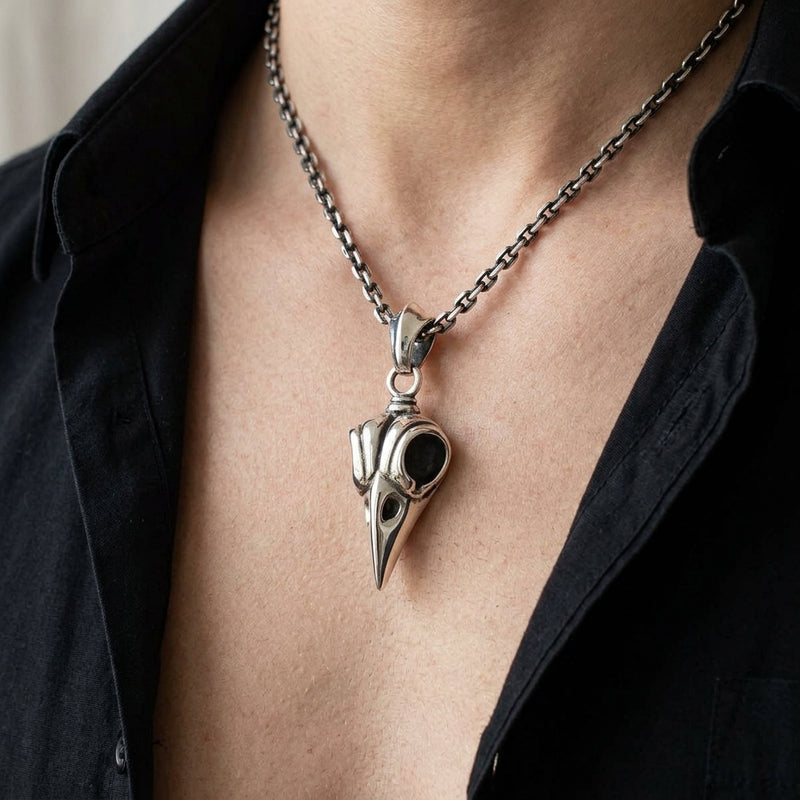
Small Crow Skull Sterling Silver Pendant
A plainer 16 × 37 mm outline with a tapered beak, polished ridges and an open back.
View crow pendant detailsExplain your choice in one sentence
When someone asks what your necklace means, a specific sentence works better than a list of symbols, because it describes your reason instead of claiming a universal one. Name the reference you chose and, if you like, the detail that connects to it.
Two suggested ways to phrase it: “I keep rereading Poe’s ‘The Raven,’ and this is my quiet reference to it.” Or: “It doesn’t stand for anything in particular. I just like the long beak against the polished silver.” Both are honest, and neither asks the pendant to prove more than it can.
If you are still deciding which outline suits your reason, you can compare more designs in our pendant collection.

