

A skull on a ring doesn't tell you, by itself, whether the piece is about mourning, about mortality or simply about a striking design. The short answer: memento mori names a purpose, which is a reminder that life is finite. Mourning jewelry names a different purpose, which is commemorating a particular person who died. A skull is a visible motif that may serve either purpose, both or neither.
Because the labels describe different aspects of an object, one piece can carry more than one. If you love dark art, the useful skill is telling which claims a seller can document and which meanings belong to you as the wearer.
Three labels answering three different questions
Memento mori is usually translated as “remember that you must die.” In jewelry, the term describes an object meant to keep mortality in mind. The question it answers is what the piece reminds the wearer of.
Mourning jewelry commemorates someone who has died. The question it answers is who is being remembered. Establishing that usually takes documentation, such as a name, a date or a record of the person the piece concerns.
A skull motif is simply what you can see, so the question it answers is what the design shows. A skull can appear on a reminder of mortality, on a memorial or on a contemporary design without a documented memorial purpose.
Read the documented context before drawing a firm line between the labels. The two museum records below show why.
Two museum rings that show how the labels overlap
A wedding ring that is also a memento mori
In a 2015 Met essay, curator C. Griffith Mann discusses a German gimmel ring dated 1631. Its two hoops can separate, and hidden cavities hold a small baby figure and a skeleton. An inscription relates to marriage, and the curator identifies the ring as both a wedding ring and a memento mori.
The essay documents a marriage function and a mortality reminder; it does not identify the ring as commemorating a particular death. It shows that a mortality reminder can sit inside a ring made for a wedding. The curator's full discussion is in Celebrating Life and Death with Rubies.
A memorial ring that also shows a skeleton
The Met's record for a 1757 ring (2024.222) defines mourning jewelry as commemorating the dead. Gold lettering on black enamel names Sarah Rawson and records her death in 1757. A coffin-shaped cut crystal reveals a white skeleton on a dark background.
The name together with the recorded death identifies the person being commemorated; the skeleton supplies a mortality image. That gives one object two functions. It is evidence of overlap, not a rule that every skull means mourning.
How the three examples differ
| Example | What is documented | How to read the claim |
|---|---|---|
| 1631 gimmel ring | A wedding inscription and hidden baby and skeleton figures; the curator identifies a memento mori. | A mortality reminder can coexist with a marriage function. The essay does not identify a commemorated death. |
| 1757 ring, Met 2024.222 | Sarah Rawson's name and death date, with a skeleton beneath coffin-shaped crystal. | Named remembrance and a mortality motif coexist in this recorded object. |
| Modern pieces below | Skull motifs and stated product materials, measurements and options. | Those details describe the design. A personal memorial association belongs to the wearer unless a different purpose is documented. |
A skull or black enamel alone does not identify a person being commemorated. Look for a documented connection rather than classifying a piece by color.
Read a listing in three passes
- Observable motif. Note what is actually shown, such as a skull, bones, flowers, a worm or a coffin shape. Describe it before you interpret it.
- Materials, construction, date and provenance. Look for stated metals, how the piece is built, any stated date and any ownership history. If a listing gives sterling silver and measurements but no supported date or ownership history, those details do not establish an antique origin. Leave that historical claim unverified. Materials alone don't date a design.
- Your own reason. Decide what the piece means to you. It might be a reminder of finite time, a private tie to someone you remember or admiration for the form. That meaning is legitimately yours, and the seller doesn't need to have intended it.
Keep the first two passes separate from the third. That separation is what stops a modern ring from being described as an antique memorial, whether in a resale listing, a gift note or your own account of the piece.
Two modern skull designs, read this way
Gothicrock offers both pieces below as contemporary jewelry. Neither is presented as an antique or as a reproduction of either Met ring, and neither listing documents a memorial identity. A wearer can still use either one to remember someone. In that case, the meaning comes from the wearer rather than the listing.
Skull and Rose Sterling Silver Ring
Pass one: a rose and a small skull-and-bone relief set among curling botanical forms. Pass two: .925 sterling silver with oxidized recesses and polished high points. It weighs about 16 g, and the face measures roughly 0.9 × 0.5 in (about 22.9 × 12.7 mm). Pairing a rose with a skull is a design choice. It doesn't prove a love-and-death or vanitas intent.
Practical check: the ring is listed in standard ring sizes rather than as an adjustable band, and available sizes vary, so confirm that yours is offered. For width and profile questions, see our guide to gothic ring styles.
Worm Skull Sterling Silver and Brass Pendant

Pass one: an asymmetric skull with a brass-colored worm emerging from one eye socket. One side is smooth, the other is engraved with a floral pattern, and the recesses are dark. Pass two: .925 sterling silver and brass, with no stones, at about 29 g. You might associate the worm with decay. That personal reading does not establish a historical model, a commission or a mourning purpose.
Practical check: the current listing doesn't say whether a chain is included or how large the bail opening is. Before ordering, confirm what comes with the pendant and whether your own chain will pass through the bail.

Skull and Rose Sterling Silver Ring
Botanical and skeletal relief in one modern sterling silver ring. Inspect the rose, small skull and bone relief in the product gallery.
View ring details and sizes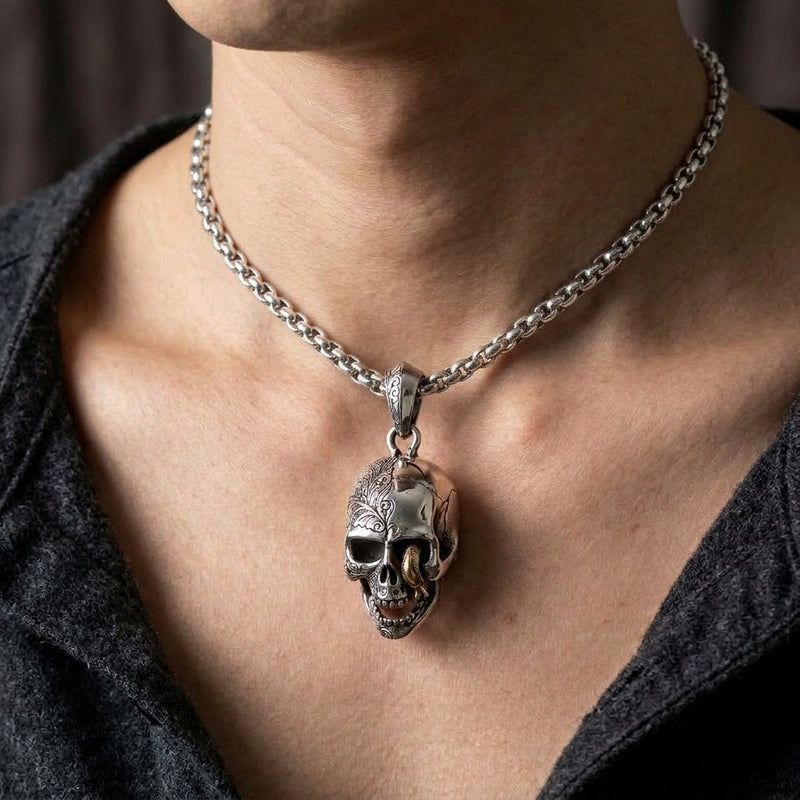
Worm Skull Sterling Silver and Brass Pendant
An asymmetric skull with a brass worm and two metals to inspect. Compare its engraved and smooth skull surfaces in the gallery.
View pendant detailsChoosing for yourself or as a gift
If the piece is for you, the third pass is the decision. Ask what you want it to carry: a private name, a reminder of finite time or simply a design you enjoy wearing.
For a gift, the recipient's view matters more than the symbolism you intend. These questions can help:
- Do they already wear skull imagery, or might a skull read as a comment on a recent loss?
- If you mean the piece to mark someone who died, would they welcome that connection, or would they rather choose a memorial piece themselves?
- Would they prefer an open motif with no stated meaning, so the interpretation stays theirs?
- Does the format work for them, whether that means a listed ring size or a pendant that suits a chain they already own?
A gift note that states your reason plainly, such as “in memory of…” or “because you love this art,” avoids implying a history the object doesn't have.
When you're ready, compare contemporary skull designs.

