

In Scottish Rite jewelry, the double-headed eagle represents an association with that branch of Freemasonry. The emblem appears on rings and other items worn by members. Its history predates the Scottish Rite, however, so two eagle heads alone do not establish a ring’s origin or its wearer’s affiliation. Read the specific design in its stated context.
For a Scottish Rite ring, the useful questions are concrete: which wing position does it show, what conventions apply to the intended wearer, and what size and material does the listing offer?
Start with how the ring will be used
If you are choosing a ring to express Scottish Rite membership, begin with the wearer’s own organization and its expectations. A product name can help you find a design, but it cannot decide which emblem is appropriate for a particular member or occasion.
If the eagle and silver scrollwork are what interest you, look at those details in the gallery while keeping the fraternal association in mind. For a gift, ask whether that association is part of what the recipient wants. Their answer is more useful than assigning a meaning to them.
Wing position: a convention in the Northern Masonic Jurisdiction
One detail to check is whether the eagle’s wings are raised or lowered. According to Scottish Rite NMJ, in the Northern Masonic Jurisdiction the wings-up design is reserved for 33° Active and Active Emeritus Members of the Supreme Council, while other Brothers wear the eagle with wings down.
Keep the scope of that statement in view:
- Check the jurisdiction. Ask the relevant Scottish Rite body before applying this convention elsewhere.
- Keep the full qualification. The NMJ reservation is narrower than “every 33° Mason.”
- Do not infer a degree from lowered wings. They do not, by themselves, establish 32° status.
What a ring listing can and cannot confirm
Use the listing to check the object and the wearer’s organization to check fraternal expectations. Photographs and specifications can answer questions about the ring’s design, metal and dimensions. They cannot verify the purchaser’s membership or authorize a particular use.
| Buyer question | Evidence needed | What a retail description can show |
|---|---|---|
| How is this design identified? | The seller’s stated design and clear views of the emblem | A Scottish Rite label and a two-headed eagle motif; official approval needs separate documentation |
| Which wing position suits the wearer? | The recipient's jurisdiction and status, confirmed by them or their local body | Whether the wings are raised or lowered |
| Is it the right material and scale? | The stated metal, face dimensions and weight | The object’s specifications; these are separate from its symbolic use |
| Will it fit? | The recipient's measured ring size | Size options and the dimensions of the ring face |
One example: a lowered-wing sterling silver ring
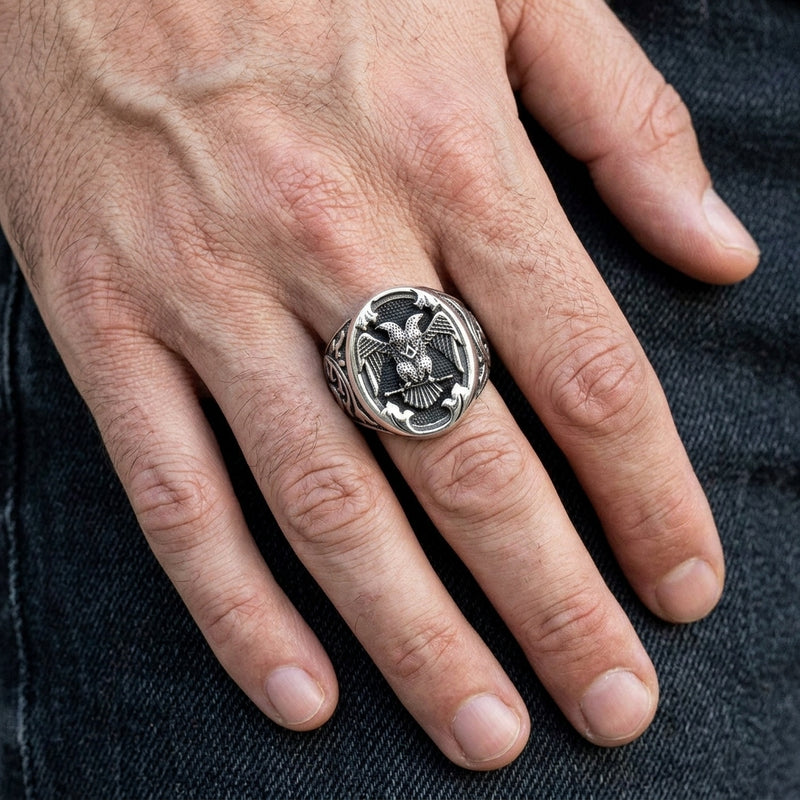
The Scottish Rite Double-Headed Eagle Silver Ring shows how these details appear on a real listing. Its product page describes:
- solid .925 sterling silver, with a .925 hallmark inside the band
- a double-headed eagle with lowered wings
- blackened recesses and scrolling shoulders
- a face of approximately 0.65 × 0.85 inch (about 16.5 × 21.6 mm)
- an approximate weight of 13 g
- selectable US ring sizes
In the product photos, the two heads face away from each other above lowered, feathered wings, with geometric detail at the center, a horizontal sword and scrollwork around the design. The figures above are listing specifications, not independent measurements.
The face measurement describes the top of the ring, while ring size concerns its fit around a finger. Compare them separately. For how face size, band width and profile affect fit and feel, see our guide to gothic ring styles.

Gift checklist
- The intended meaning. Ask whether the recipient wants a ring connected with their Scottish Rite membership or is interested in the eagle design itself.
- Local expectations. Ask them, or their local Scottish Rite body, which design is appropriate for fraternal wear, including wing position.
- Personal preferences. Consider metal tone, how large a ring face they are comfortable wearing and whether it is for daily or occasional wear.
- Exact size and material. Get their measured US ring size, confirm sterling silver suits them and check that the size is offered when you order.
For a fraternal gift, settle the design question with the recipient before choosing a size. For a gift chosen for its appearance, confirm that they welcome the emblem’s association as well as its look. To compare other designs, browse available rings.

