

Choose the open-wing phoenix if you want one bird with a wide, detailed outline that reads as a single piece at the neckline. Choose the split dragon-and-phoenix medallion if you want something compact that can be shared: it separates down the middle into two halves, each with its own loop, so it can be worn whole or divided between two people.
Both pendants are listed as sterling silver with a 925 stamp on the back. Their main difference is construction. The comparison below is drawn from the current product listings and their product photos, not from a hands-on fit or comfort test.
One continuous bird, wings fully open
The Phoenix Bird Sterling Silver Pendant is a single continuous bird motif. Its feathered wings spread asymmetrically rather than as a mirrored pair, the head carries a crest, and the tail curls away in openwork, so part of the outline is open space rather than solid metal.
The surface relies on contrast. Grooves between the raised feathers are darkened, while the high points are polished, which keeps the wing detail readable instead of flattening into one bright shape. A tapered bail—the loop for the chain—joins the bird through a small connecting ring at the top.
The listing gives an approximate size of 40 × 45 mm and an approximate weight of 12 g. It does not say whether the bail is included in that measurement or which figure is the height. Its wings and tail form one continuous motif, designed to be worn together on one chain.
A medallion made to come apart
The Dragon Phoenix Split Sterling Silver Pendant starts as a round medallion with a straight split running down its center. Two loops sit side by side at the top, one on each half. Once separated, each piece has a straight inner edge and a curved outer rim, so each half still looks finished on its own rather than like a broken fragment.
Gold-plated central detail adds warm color against the silver and darker relief. This is a sterling silver pendant with plated detail.
The listed assembled dimensions are 1 × 1⅜ inches (about 2.54 × 3.49 cm), and the listed weight is 15 g. Both figures describe the pendant as a whole. Separate sizes and weights for each half are not listed, so it is safer not to treat either half as an exact fraction of those numbers. The listing does not identify a fastening mechanism that holds the halves closed, so do not assume they lock together.

The pairing also appears in historical jewelry: a dragon-and-phoenix pendant in the Bowers Museum is carved in nephrite and cataloged as Chinese, dated 475–221 BCE. That record provides context for the paired motifs; it does not establish the origin or meaning of this modern design.
How the two designs compare
On small screens, scroll across the table.
| Pendant | Construction | Listed size | Listed weight |
|---|---|---|---|
| Phoenix Bird | One continuous bird in sterling silver; tapered bail on a small connecting ring | About 40 × 45 mm (bail inclusion not stated) | About 12 g |
| Dragon Phoenix Split | Round sterling silver medallion with gold-plated central detail; splits into two halves, one loop each | 1 × 1⅜ in (about 2.54 × 3.49 cm), assembled; per-half size not listed | 15 g for the pendant; per-half weight not listed |
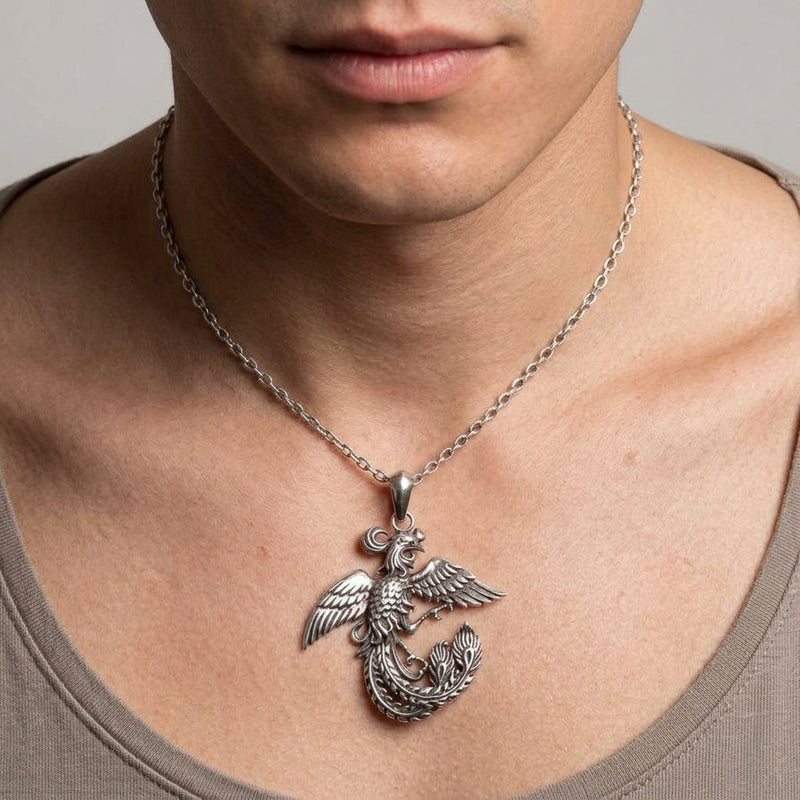
Phoenix Bird Sterling Silver Pendant
One open-wing bird with an openwork tail, listed at about 40 × 45 mm, for one continuous bird silhouette.
View details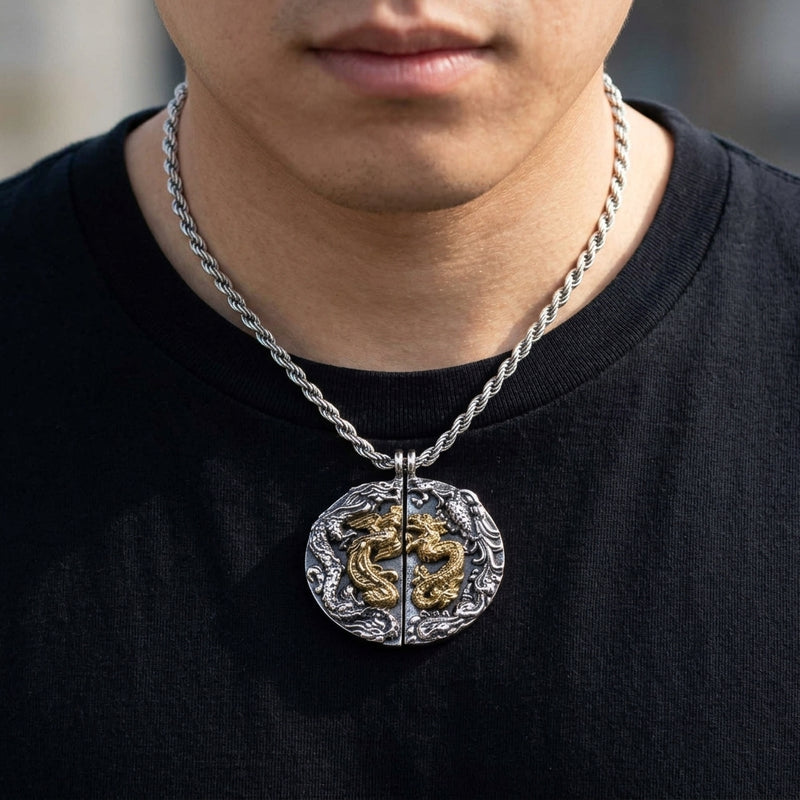
Dragon Phoenix Split Sterling Silver Pendant
A compact medallion that separates into two halves, each with its own loop, with gold-plated central detail.
View detailsPlanning the chain
Plan your wearing chain separately. Neither pendant includes a complimentary leather necklace or cord, and a chain shown in a styling image is not evidence that it is supplied. The open-wing phoenix needs one chain through its tapered bail. The split medallion needs more thought: worn whole, a single chain would have to pass through both neighboring loops, and worn apart, each half needs its own chain. If the halves are a shared gift, budget for two chains.
Loop and bail openings are not listed for either design, so check the bail and chain end before you pick a chain.
Making the call
Decide what the pendant needs to do. If you want the phoenix itself to be the whole statement, with spread wings and an openwork tail, the open-wing bird fits that role. If you want a round, two-tone design that can become two separate keepsakes, the split medallion is the one built for it.
If neither shape is quite right, explore animal jewelry for other creature designs.

