

The five bracelet listings below use two kinds of size label. The two cuffs give a wrist range: the wrist measurement the piece is written for. The three chain bracelets give closed lengths: how long the bracelet measures when fastened. Measure your wrist first, check which kind of number a listing uses, and only then compare the two.
Measure the wrist you will wear it on
Rest a flexible tape on the skin of the wrist you plan to use, without pulling it tight. Without a tape, wrap a paper strip or string around the wrist, mark the overlap, lay it flat and read it against a straight ruler. Ines Bouwen's bracelet size guide describes the same method. Use it for technique only: its letter sizes belong to that brand and do not correspond to Gothicrock options.
A bracelet you already own can be a useful reference if it is built the same way, so compare a chain with a chain and a cuff with a cuff. Note how it sits and how you measured it, including whether the clasp was counted.
Wrist range or closed length: read the label first
- Open cuff: a rigid band with a gap instead of a clasp or hinge, sized by a stated wrist range.
- Hinged cuff: a rigid band that opens at a hinge, also sized by a stated wrist range. The hinge lets it on and off; it does not make the cuff adjustable.
- Chain bracelet: flexible links joined by a clasp, sized by closed length. That number describes the bracelet, not your wrist.
The same figure can therefore mean different things. An 8 in wrist fit on a cuff is a wrist measurement. An 8 in chain is the fastened bracelet, and how much room it leaves depends on its links and clasp.
Cuffs: match your wrist to the stated range
The Snake sterling silver cuff is an open cuff with a slim band 3 mm thick. Its listing says it adjusts to fit wrists from approximately 6.5 to 7 inches (16.5 to 17.8 cm). Treat that as the full stated range; the listing gives no guidance for wrists outside it.

The Ruby Eye Double Dragon cuff is hinged, with a 15 mm band and a stated fit of 8–8.5 inches (approximately 20.3–21.6 cm). The listing says not to bend it to change its size: it opens at the hinge, so the stated fit is the deciding number. If your wrist sits outside 8–8.5 inches, the hinge does not change the answer.

The two cuff ranges do not overlap, so no single wrist falls within both. Neither listing gives an inside circumference or opening measurement; if your wrist is at the edge of a range, ask before ordering.
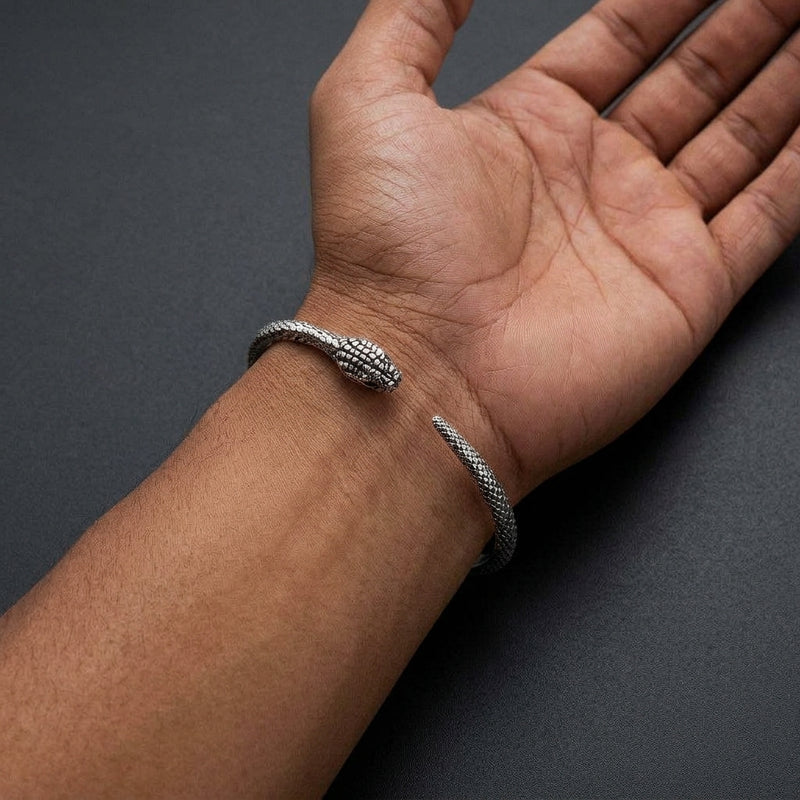
Snake Sterling Silver Adjustable Cuff Bracelet
An open sterling silver cuff stated for wrists of approximately 6.5–7 in (16.5–17.8 cm), with a slim 3 mm band.
Check the wrist range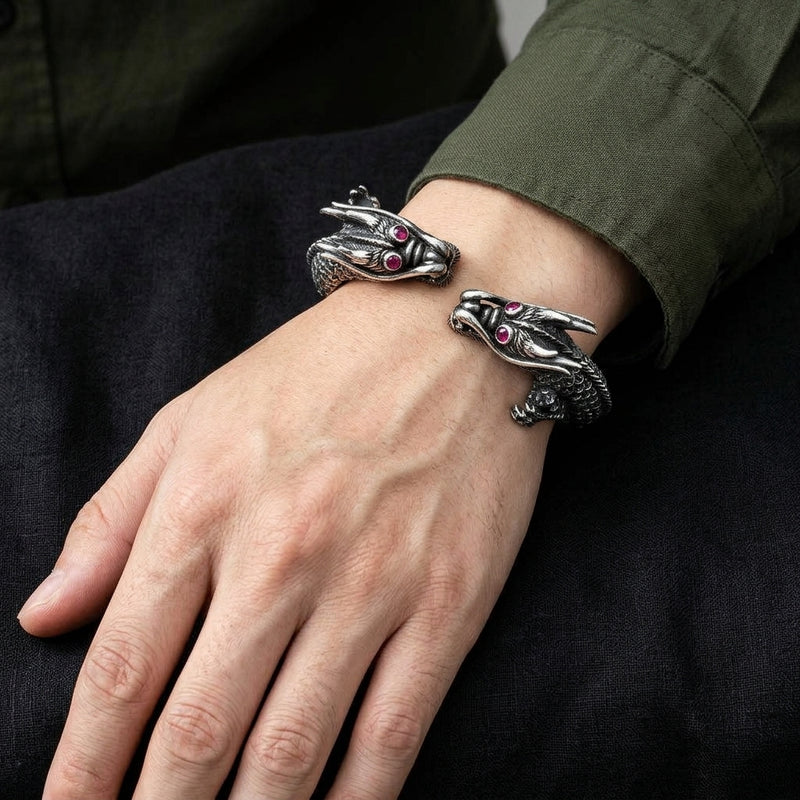
Ruby Eye Double Dragon Sterling Silver Cuff
A hinged cuff with four lab-created ruby eyes and a stated wrist fit of 8–8.5 in (20.3–21.6 cm); it opens at the hinge rather than bending.
Check the wrist fitChains: choose the closed length
With a chain, you decide how much longer the bracelet should be than your wrist. A 7 in wrist and an 8 in bracelet differ by 1 in, but that difference is not a guaranteed amount of clearance: thick links sit above and around the wrist, and the clasp is part of the length. We do not apply one add-on rule to every chain, because the same allowance behaves differently across link shapes. Link width tells you how much metal crosses the wrist, not how much space is left inside, so you cannot subtract it from the length to find an interior figure.
The Motorcycle Piston link bracelet has 14 mm articulated links and lists closed lengths of 7.5, 8, 8.5, 9 and 9.5 inches. Its listing is explicit that the selected measurement describes the bracelet, not the wrist. Look at the clasp in the product gallery before deciding how much extra length you want.
The Rider Dragon link bracelet is about 5/8 in (roughly 1.6 cm) wide, and the dragon's mouth closes around a substantial round ring. The listing notes that the clasp and thick links form part of the overall length, so a large sculpted fastening takes up part of the loop. Lengths are chosen from the options on the product page.
The Heavy Cuban link bracelet is approximately 18 mm wide by 5 mm thick, with a box clasp and side safety latch, in five closed-length options. Its listing gives its own suggestion for this thick chain: add approximately 1 to 1.25 inches (about 2.5 to 3.2 cm) to a bare-wrist measurement, then choose the closest listed length. That suggestion belongs to this bracelet; don't carry it over to other designs.

Motorcycle Piston Sterling Silver Link Bracelet
14 mm articulated piston links with listed closed lengths from 7.5 to 9.5 in; confirm the current options in the selector.
View closed lengths
Rider Dragon Sterling Silver Link Bracelet
Engraved links about 5/8 in wide with a dragon-mouth clasp that forms part of the overall length.
View available lengths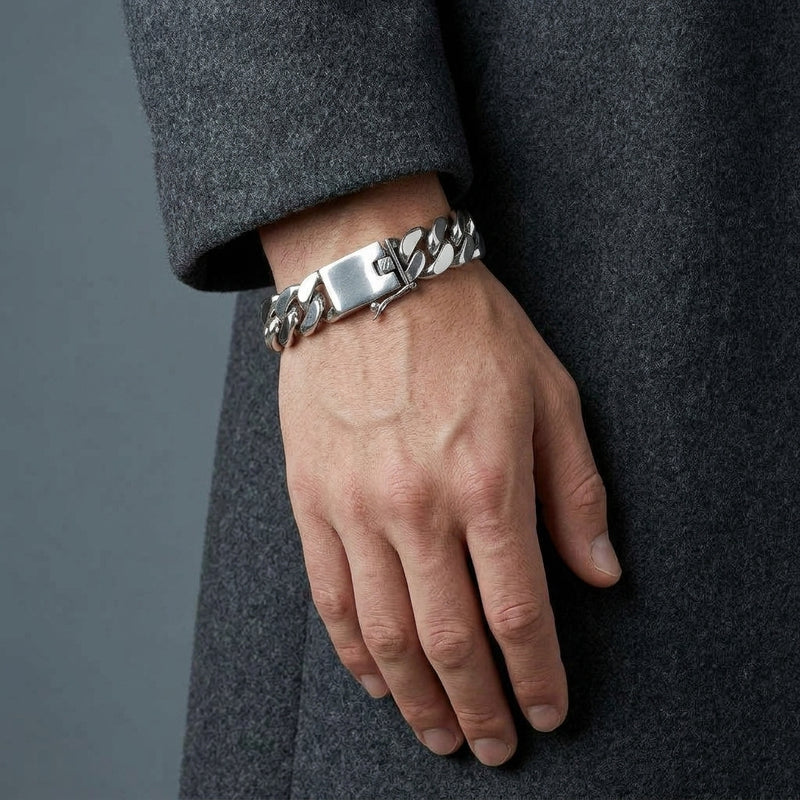
Heavy Sterling Silver Cuban Link Bracelet
Broad 18 mm Cuban links with a box clasp and side safety latch, offered in five closed-length options.
View closed lengthsFive designs side by side
| Design | Construction | Size number describes | Stated size | Stated dimension | Listed weight |
|---|---|---|---|---|---|
| Snake cuff | Open cuff | Wrist range | 6.5–7 in (16.5–17.8 cm) | 3 mm band thickness | About 19.5 g |
| Ruby Eye Double Dragon | Hinged cuff | Wrist fit | 8–8.5 in (20.3–21.6 cm) | 15 mm band width | About 80 g reference item weight |
| Motorcycle Piston | Chain | Closed bracelet length | 7.5, 8, 8.5, 9, 9.5 in (19.1–24.1 cm) | 14 mm link width | About 52 g; varies with length |
| Rider Dragon | Chain | Overall length, clasp included | Options on the product page | About 5/8 in (1.6 cm) width | About 118 g; size not specified |
| Heavy Cuban link | Chain | Closed bracelet length | Five options on the product page | 18 mm wide × 5 mm thick | About 140 g; length not specified |
The dimension column is not like-for-like: the Snake cuff's figure is band thickness, and the others are widths. Weights are the approximate figures each listing gives, so read them as references rather than the weight of every size.
Before you order
Listed lengths and selectable lengths are not always the same, and product text can differ from the current options. Open the product page and read the size selector; it is the current statement of what you can choose. Don't plan on bending a sculpted cuff or resizing solid silver links yourself to correct a fit.
Ask for an extra measurement when your wrist sits at the edge of a cuff range, when a large clasp clearly takes up part of a chain, or when no available length matches your reference bracelet. Specific questions get useful answers:
- For a cuff: what is the inside circumference, and how wide is the opening?
- For a chain: is the closed length measured end to end including the clasp, and what is the interior circumference when fastened?
- For a listed weight: which size does it refer to?
If you are still comparing shapes, browse the bracelet collection and note each listing's construction and size label. Once the size is settled, our guide to gothic jewelry for men covers how a heavy wrist piece works with the rest of an outfit.

