

Pick the outline first. An oval amethyst bishop ring gives you a rounded, broad face. A square one gives you four corners and a compact, geometric frame. A marquise stretches into a narrow shape pointed at both ends.
Metal finish is a separate decision. The square and marquise designs each come in sterling silver and in gold-plated silver, so you can settle on a shape and choose the color afterward.
Three measurements, three questions
The listings use three kinds of figures, and each answers something different:
- Center-stone size tells you how large the amethyst itself is.
- Full-face size tells you how much area the whole ring head covers, including the halo or frame.
- Item weight is the weight of the entire ring in grams. It is not the stone's carat weight.
Compare like with like. A 6 × 14 mm center stone and a 19.1 mm face are not competing numbers; one describes a gem, the other a whole ring head.
The five rings side by side
| Design | Center stone | Full face | Listed item weight |
|---|---|---|---|
| Oval, sterling silver | 18 × 20 mm, 21 ct | 1 × 1 1/8 in (approx. 25.4 × 28.6 mm) | Approx. 22 g |
| Square, silver with gold-plated crosses | Not stated | 3/4 × 3/4 in (approx. 19.1 × 19.1 mm) | Approx. 13.5 g |
| Square, gold-plated silver | Not stated | 3/4 × 3/4 in (approx. 19.1 × 19.1 mm) | Approx. 13.5 g |
| Marquise, sterling silver crozier | 6 × 14 mm | Not stated | Approx. 12 g |
| Marquise, gold-plated crosier | 6 × 14 mm | Not stated | Approx. 12 g |
On small screens, scroll sideways to see every column.
The gaps are real gaps in the listings. The square rings give a full face but no center-stone dimensions; the marquise rings give a center stone but no full face. None of the five lists a ring height. Stone disclosure varies as well: only the oval ring and the silver marquise identify their amethyst as natural, while the other three simply say amethyst. Only the oval ring identifies its clear halo stones as cubic zirconia. The clear accents on the square and marquise rings are not identified by mineral.
Oval: a rounded face with cross shoulders
The oval example has a larger listed face and a higher listed item weight than either square example. Its natural amethyst center is listed at 18 × 20 mm and 21 ct, set in a halo of 36 clear cubic zirconia stones. The whole face is listed at 1 × 1 1/8 inches (approximately 25.4 × 28.6 mm), and the sterling silver ring weighs about 22 g.
Keep those last two figures apart. The 21 ct describes the stone alone; the 22 g describes the whole ring.
With no points or corners, the oval face reads as one continuous curve of purple ringed by clear stones. A cross sits on each shoulder. The oval example selected here is sterling silver without a gold finish.
Outline is a style choice, not a quality signal. GIA's amethyst buyer's guide shows the gem cut in many fancy shapes, and picking one tells you nothing about a particular stone's grade. None of these listings includes a grade.
Square: one outline, two finishes
The two square rings share their structure: a violet amethyst framed by 24 small clear accent stones, a listed face of 3/4 × 3/4 inch (about 19.1 × 19.1 mm) and an approximate weight of 13.5 g. That 19.1 mm figure covers the whole face, frame included, not the stone.
The four-cornered outline gives the face straight edges and a more architectural look than the oval. It is also noticeably more compact: roughly 19 mm square against the oval's roughly 25 × 29 mm face.
Silver body with gold-plated crosses
This version has a .925 sterling silver body with wide shoulders and gold-plated cross details on the sides. Its listing describes the center as princess-cut and notes a 925 hallmark inside the band. The band itself stays silver-colored, with gold plating on the crosses.
Gold-plated body with silver-tone crosses
The second version reverses the contrast. A sterling silver core carries 14K gold plating, so the band reads warm, while the shoulder crosses are silver-tone. Its listing describes a square violet amethyst without naming a cut.

Both square rings combine contrasting metal tones with a stone setting. Check the plated areas before choosing a cleaning method. The Gothic silver care checklist covers gentle cleaning and storage for mixed finishes.
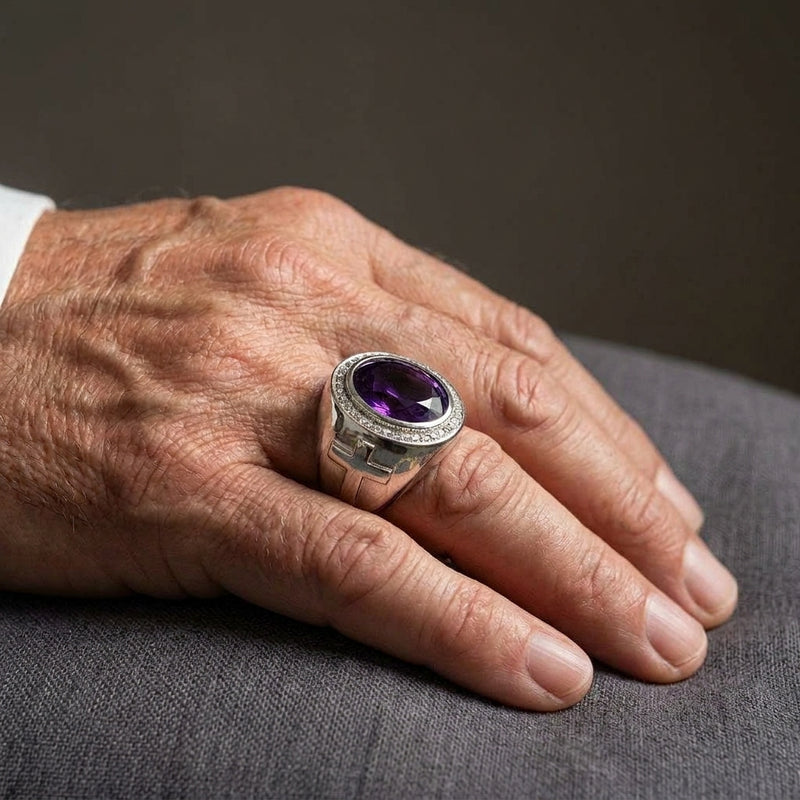
Natural Amethyst Sterling Silver Bishop Ring
An 18 × 20 mm oval natural amethyst in a cubic zirconia halo, with a separately listed full face of 1 × 1 1/8 inches.
View details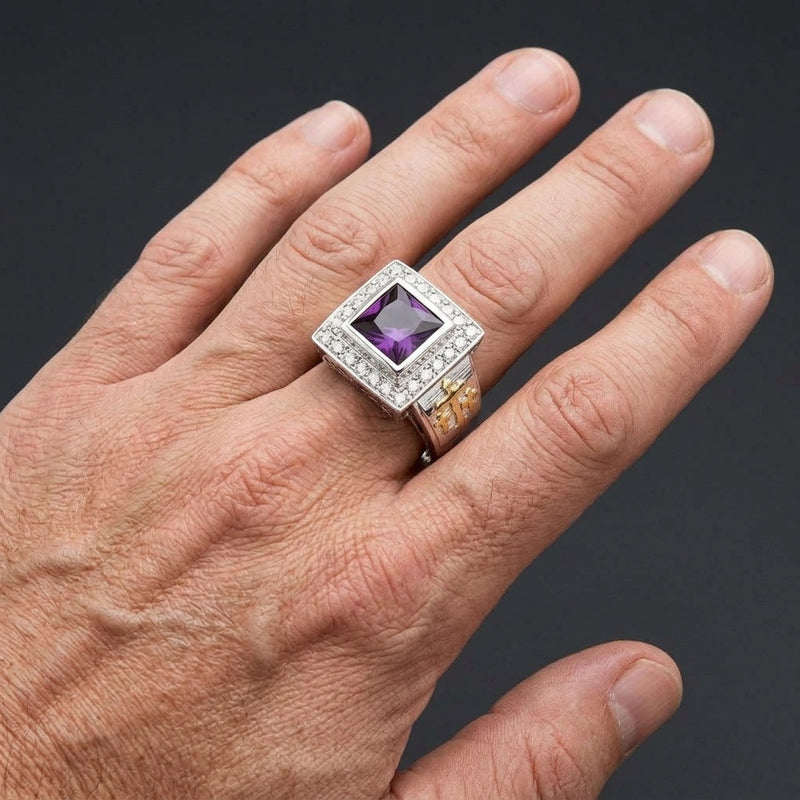
Square Amethyst Silver Bishop Ring with Gold Crosses
A 19.1 mm square face on a silver body, with gold-plated crosses on the shoulders.
View details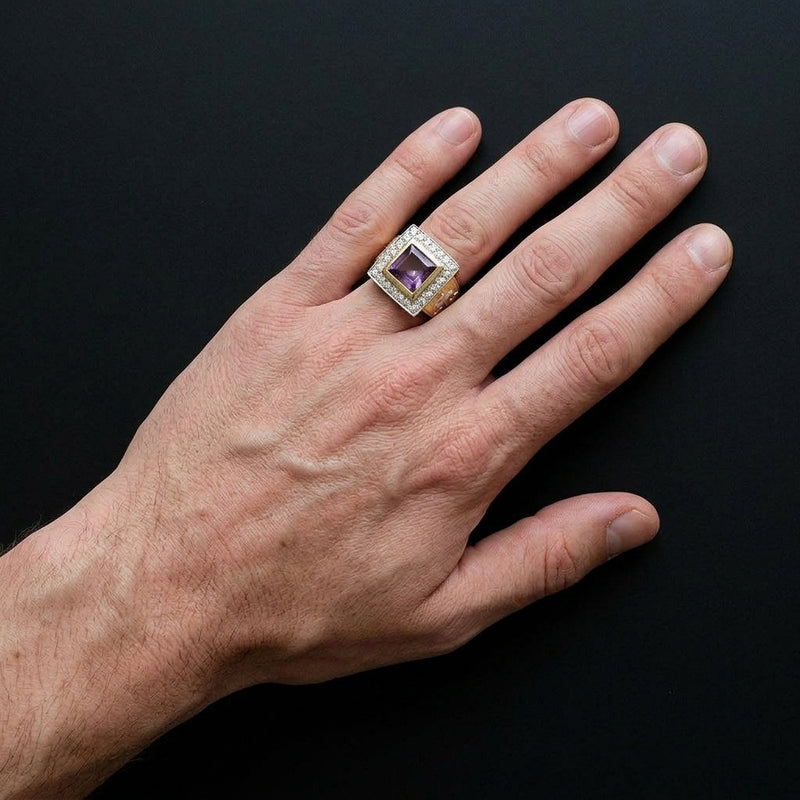
Square Amethyst Gold-Plated Silver Bishop Ring
The same square face on 14K gold-plated silver, with silver-tone crosses for contrast.
View detailsMarquise: long, narrow and pointed
The marquise center has an elongated, pointed outline. Both marquise rings set a faceted 6 × 14 mm amethyst, pointed at each end, among clear accent stones, and both are listed at about 12 g.
Neither listing gives a full-face measurement. So don't line up 6 × 14 mm against the square's 19.1 mm face or the oval's 25.4 × 28.6 mm face. The clear-stone frame extends beyond the amethyst; its full dimensions are not stated.
Both rings carry a curved staff motif on the shoulders. One listing spells it crozier and the other crosier; both describe the hooked pastoral staff shape. The motif alone does not establish the wearer's rank or whether the ring suits a particular ceremony.
Sterling silver crozier
The silver version sets a natural marquise amethyst within rows of clear accent stones. Raised crozier relief runs along the shoulders, and open filigree beneath the setting makes the gallery visible from the side. The listing states it was made in Thailand.
Gold-plated crosier
The gold version uses a sterling silver base with 14K gold plating. Its crosier detail sits on a tapered band, and clear stones frame the purple center. The listing names the stone as amethyst without stating whether it is natural.
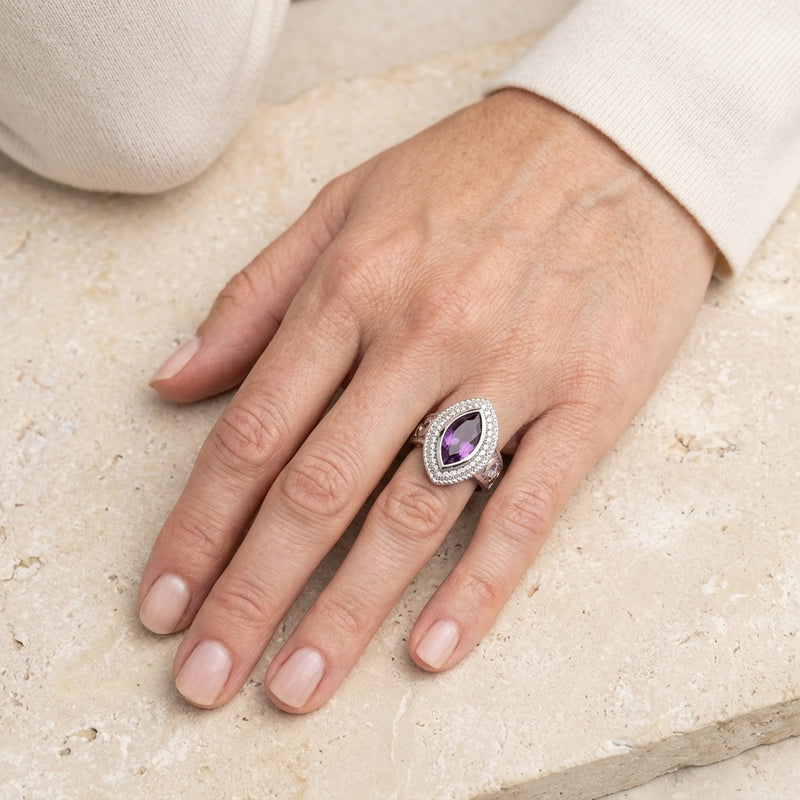
Marquise Amethyst Crozier Sterling Silver Bishop Ring
A natural 6 × 14 mm marquise amethyst with crozier shoulders and an openwork gallery in sterling silver.
View details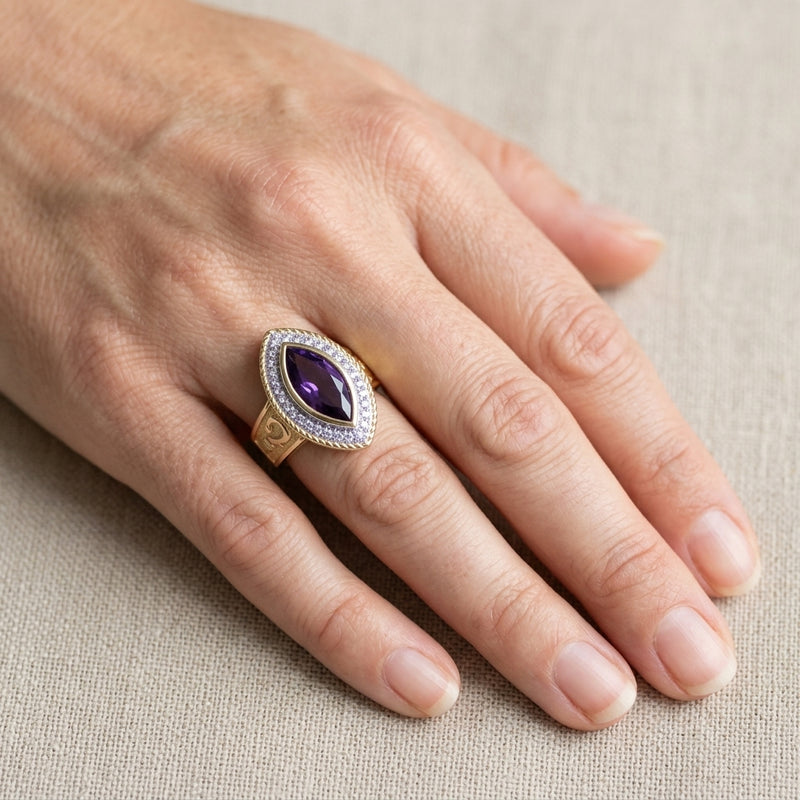
Marquise Amethyst Gold-Plated Crosier Ring
The same 6 × 14 mm marquise outline on 14K gold-plated silver, with a crosier detail on a tapered band.
View detailsA simple way to compare
- Choose the outline. Rounded oval, four-cornered square or elongated, pointed marquise.
- Look at the shoulders and gallery. Crosses on the oval, contrasting crosses on the square pair, curved staff motifs on the marquise pair, plus open filigree on the silver marquise.
- Pick the finish. The square and marquise designs each come in sterling silver or gold-plated silver; the oval example in this comparison is silver without gold plating. Within each pair, the available measurements and approximate weights match.
- Confirm your US ring size. If you know your size in another system, convert it with the ring size conversion chart.
To see these designs alongside other purple-stone pieces, browse the amethyst rings collection.

