

Hannya is a name with a specific home. In Noh theatre it identifies one mask type: a female demon or a woman transformed by resentment. Oni is a much wider word for the horned, fanged figures found across Japanese legend. So a horned Japanese mask is not automatically a Hannya. An Oni or Hannya title on a piece of jewelry tells you how the seller has named the design. It does not tell you which stage mask or story the piece reproduces. Read the face first, then the material label, then the format.
Reading three designs: face first, then material
The Hannya necklace: a named mask in mixed metals
The Hannya Mask Sterling Silver and Brass Pendant Necklace is the only one of the three that uses the theatre name. Its face is darkened sterling silver and its horns are brass-toned. The listing mentions clear stone accents but does not identify the stone. The mask measures 19 × 34 mm. The listing also answers a common misreading directly: the main design is a Hannya mask, not a skull.
The brass horns are a jewelry material choice. They are not a record of how a stage mask is painted, so the color contrast should not be read as a code for a role or a rank.
The two-tone Oni pendant: one face, two metals
The Two-Tone Silver and Copper Oni Mask Pendant divides its face between cool sterling silver and a warm half. The listing confirms that the warm half is real copper, not rose-gold plating. Horns, deeply carved eyes and protruding fangs place the design within the broad oni description above. The split between metals creates contrast. The listing does not give a separate symbolic meaning to either half. The listed size is 7/8 × 1 3/8 inches (2.22 × 3.49 cm), and a shaped loop sits above the head. The reverse view in the gallery shows the back and the attachment point.

The Oni ring: a face that wraps the finger
The Japanese Oni Mask Sterling Silver Ring is polished .925 sterling silver. It has two pointed horns, deep eyes and bared teeth. Engraved motifs continue onto the shoulders, so the design reads from the side as well as from the front. The listed ring face is 3/4 × 1 3/8 inches (approximately 19.1 × 34.9 mm), and the approximate weight is 22 g. Those face figures describe the top of the ring. They are not your ring size.
The three designs side by side
On small screens, scroll across the table to compare all three designs.
| Detail | Hannya pendant necklace | Two-tone Oni pendant | Oni mask ring |
|---|---|---|---|
| Name used in listing | Hannya | Oni | Oni |
| Format | Pendant with chain | Pendant | Ring |
| Materials | .925 sterling silver with brass and clear stone accents (stone not identified) | 925 sterling silver and real copper | .925 sterling silver |
| Listed mask or face size | 19 × 34 mm | 7/8 × 1 3/8 in (2.22 × 3.49 cm) | 3/4 × 1 3/8 in (approx. 19.1 × 34.9 mm) |
| Stamp | 925 hallmark on the back | 925 stamp on the back | 925 stamp inside the band |
| Format check | Includes 18-inch (45.7 cm), 2 mm sterling silver chain | No chain stated; loop opening not listed | Choose a listed US ring size |

Hannya Mask Sterling Silver and Brass Pendant Necklace
The only design here that uses the Noh mask name: darkened sterling silver with brass-toned horns, sold with an 18-inch sterling silver chain.
View necklace details
Two-Tone Silver and Copper Oni Mask Pendant
A horned, fanged oni face divided between sterling silver and real copper, with a shaped loop above the head.
View pendant details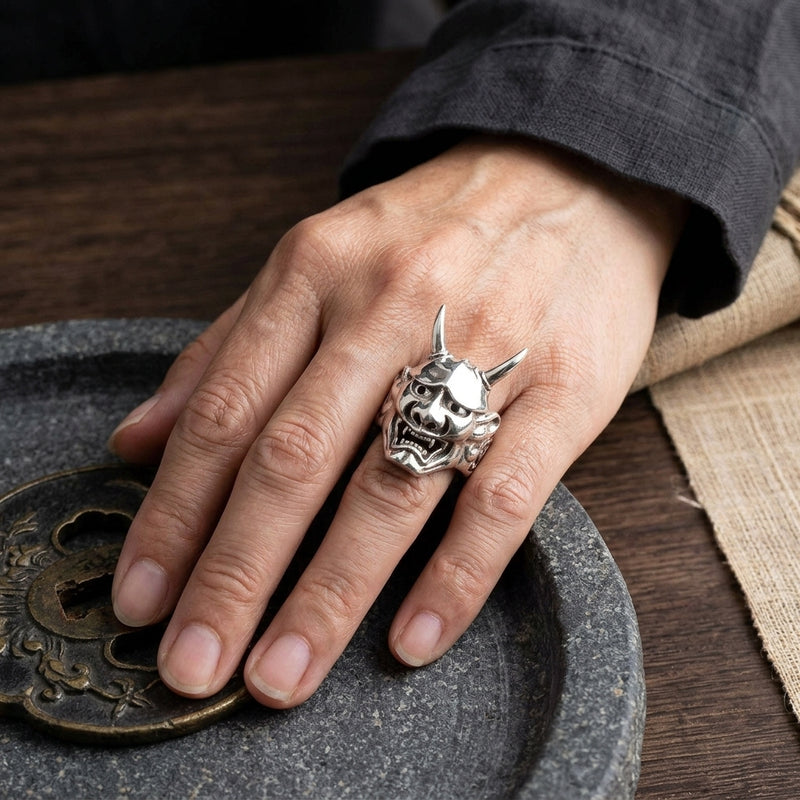
Japanese Oni Mask Sterling Silver Ring
A sculpted oni face in polished sterling silver, with engraving that continues onto the shoulders. Sold in listed US sizes.
Choose a ring sizeChoosing by meaning and by how you'll wear it
If the Noh reference is what draws you, the necklace is the only design here that names it. Reading about the mask type before you buy gives that choice more substance than the title alone. If you are drawn to the wider world of horned folklore figures, either Oni piece fits that frame without claiming a particular stage role. The remaining choice is practical: a mixed-metal pendant or a ring that shows the face on your hand.
- Look at the whole gallery. Front and side views show how the horns, eyes and fangs are shaped. They also show where the ring's engraving continues.
- Keep the name and the metal separate. Brass horns and a copper half are material choices; the listings do not establish a traditional meaning for those colors.
- Necklace: the listing includes an 18-inch (45.7 cm), 2 mm sterling silver chain.
- Two-tone pendant: the listing does not state that a chain is included or give the loop's internal opening. Confirm that the loop fits the chain you plan to use.
- Ring: the ring is sold in listed US sizes. These are size numbers, not inches. Check the current size selector, then use the ring size conversion chart rather than guessing.
- Care for the two-tone pendant: its listing recommends a gentle wipe with a soft cloth after wear and dry storage. Avoid abrasive cleaners, chemical dips and prolonged moisture.
A mask chosen for its expression, or for a story you have read and care about, is reason enough to wear it. None of these designs needs a claim of protection to be worth choosing.
If your next question is about Japanese fox masks rather than demon masks, our kitsune mask and fox jewelry guide compares a mask face with a sculpted fox head. To explore other pendant designs, browse the gothic pendants collection.

