

Corporate goth is not a shopping list. It is a set of constraints — a dress code, the tasks you do all day, and the clothes you already own — with room left inside them for one thing you actually like wearing. Get the constraints down first and the accessory choices narrow themselves.
Start with the rule that applies to you
Find the written policy before you interpret anything. Most employee handbooks say more about jewelry, visible hardware and sleeve length than people remember, and a policy you have read is easier to work with than one you are guessing at.
If there is no written rule, read the room honestly rather than optimistically. Look at what people in your role and one level above wear on an ordinary Tuesday, not at the office holiday party. If you are new, or the answer is genuinely unclear, asking a manager once is less costly than being asked to remove something in front of a client.
If you work with machinery, handle food, work in a laboratory, healthcare setting or any other restricted environment, your employer's rules on rings, chains, loose items and sleeves come first and override everything in this article. Follow them. Where a rule exists for equipment or hygiene reasons, the answer is to leave the piece at home, not to find a workaround.
Map what your hands and neckline actually do
Write down the parts of your day that involve your hands and your collar. Hours of typing. Handshakes. Carrying boxes or equipment. A headset. Video calls, where the frame is usually your face, ears, neckline and whatever you gesture with.
Each of those rules something in or out. A piece that is fine for a day of meetings can be the wrong choice for a day of packing and lifting. Most people need two answers, not one: a default and a version for the heavier days.
Do the same for the neckline. A high collar, a lanyard or an ID badge already occupies that space, and a pendant competing with a badge cord reads as clutter rather than as a choice.
Check cuff and keyboard clearance
Two physical checks settle most questions. First, the cuff: put the piece on, then button the shirt cuff over it in its normal position. If the cuff will not close, or you find yourself pushing the sleeve up all day to make room, that is your answer.
Second, the keyboard. Wide or heavy bands sit differently against a keyboard, a trackpad and the front edge of a desk than slim ones do. Type for a few minutes at your own desk, with your own keyboard, before you commit to wearing something for eight hours.
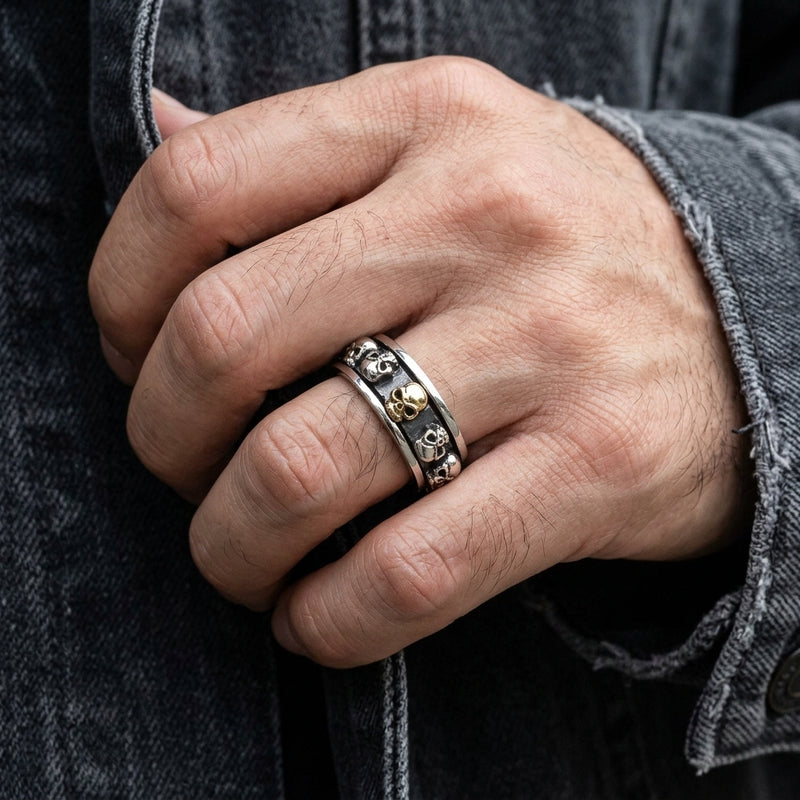
The Skull Spinner Sterling Silver Band Ring is a case where those checks matter. It is a 10 mm band in solid .925 sterling silver with a listed weight of 19 g, and the central skull has a 14k yellow-gold finish. That is a wide, substantial band with a two-tone detail, and we have not tested it for typing or for any workplace. Whether it suits your desk, your cuffs and your dress code is something only your own trial will establish.
Pick one focal point on purpose
Decide before you leave the house which single piece is meant to be noticed, then keep everything else quiet. If it is a ring, leave the neckline plain. If it is a pendant, keep your hands simple. Two competing focal points read as an outfit that has not been edited, whatever the individual pieces look like.
The gold-finished skull on the spinner band is an example of a detail that draws the eye on its own. Pair it with a plain collar rather than with a second statement, and let it be the thing people register.
An adaptable checklist for three kinds of day
| Setting | Check before you commit | Common adjustment |
|---|---|---|
| Desk-heavy day | Whether a band or bracelet contacts the keyboard, trackpad or desk edge, and whether your cuff still closes over it | Move the piece to the other hand, or shift the focal point to the neckline instead |
| Internal meetings | What is visible above a table or in a video frame: hands, cuffs, neckline, ears. Also what makes noise against a hard surface | Reduce to one focal point and remove anything that taps, slides or catches while you gesture |
| Client-facing, interview or first day | The strictest reasonable reading of the dress code, plus handshakes and passing documents across a table | Keep hardware singular and let the statement piece wait for a day when you know the room |
Adapt the rows rather than following them literally. If your job puts you in a workshop on Thursdays and in front of clients on Fridays, the checklist you need is the two-answer version described above.
Your next step
Read your dress code, then run the cuff and keyboard checks with something you already own. That tells you what width and weight your workday tolerates before you buy anything. From there, compare widths across the gothic ring collection, or look at the pendant collection if your focal point belongs at the neckline. For how a piece sits once it is on, see our practical gothic jewelry guide, and for the months when a coat and gloves join the equation, our winter outfit ideas cover the layering side.

