

An evil-eye amulet is associated with protection against the harm attributed to an envious or malicious glance. An eyeball motif describes a design that looks like an eye. These are not mutually exclusive categories: an eye can look realistic and still carry an amuletic meaning. For a modern gothic ring, examine the design, its stated context and its materials separately.
Belief, object and motif
Evil eye names a belief. The Science Museum Group’s record for a glass eye amulet describes it as the supernatural belief that a malicious glance can cause harm or misfortune.
An evil-eye amulet is an object carried or worn to ward off the harm attributed to such a glance. The term describes a protective intention or association; it does not promise an effect.
Eyeball describes what you can see: a rounded eye with a white, an iris and a pupil. It is a visual term, and on its own it says nothing about purpose.
The three can overlap. A ring can be an eyeball in form and still be worn by someone who thinks of it as an evil-eye charm, while an identical ring on another hand is purely a gothic design choice.
Realistic and stylized eyes both belong in the story
The same Science Museum record notes that eye designs on these amulets can be realistic or highly stylized. Realism alone is therefore a poor test for separating an amulet from another piece of eye jewelry. A lifelike iris does not exclude an amuletic meaning.
It works the other way, too. A blue eye, or a product name containing the words evil eye, does not by itself establish a specific cultural tradition, what the wearer believes or what the eye is made of. Museum records document belief and use; they are not evidence that an object protects anyone.
One documented example
The Corning Museum of Glass holds a small glass eye pendant from Egypt, dated 1300–1100 BCE and about 1 cm across at its widest. The museum interprets its eye form in relation to a belief in protection against an envious glance. This is a documented example of eye imagery associated with protective belief. The record does not establish that the modern rings below reproduce it or share its particular history.
Two rings, two ways to frame an eye
Both rings are listed in .925 sterling silver, and both show a white eye with a blue iris and black pupil. The difference is in how the silver presents it.
The Blue Eyeball Claw Sterling Silver Ring holds a round, domed eyeball between pointed, curved claws, with dark recesses between them. The eye looks gripped, as if something has caught it. This is the more anatomical, creature-like reading of the motif.
The Sterling Silver Blue Evil Eye Statement Ring places its eye in an almond-shaped frame, with scrolling ornament and oxidized filigree recesses set against polished silver. The outline echoes an eyelid, so the eye reads as framed rather than held. The listing calls the style Victorian; treat that as a design description, not a period date.

| Detail | Blue Eyeball Claw ring | Blue Evil Eye Statement ring |
|---|---|---|
| Frame | Pointed, curved silver claws around a round, domed eyeball | Almond-shaped frame with scrolling ornament and oxidized filigree recesses |
| Center material | Not stated in the listing; ask the seller | Blue glass eye cabochon |
| Metal | .925 sterling silver, 925 stamp inside band | Solid .925 sterling silver |
| Listed face | 7/8 × 7/8 in (approx. 22.2 × 22.2 mm) | Approx. 28 × 20 mm |
| Listed weight | Approx. 27 g | Approx. 20 g |
Why the center material matters
These eyes look alike in photos, but their listings disclose different things. The statement ring names a blue glass eye cabochon, meaning a smooth, domed glass center. The claw ring’s listing describes a blue eyeball design and confirms the silver, but it does not say what the eyeball itself is made of.
A glossy finish in a photo is not a material test, so it is best not to assume glass, resin or stone. Before choosing a cleaning method or comparing the centers’ durability, confirm what each one is made of and request care guidance for the complete piece. You can ask a specific question:
What is the blue eyeball center on the Blue Eyeball Claw Sterling Silver Ring made of, and which care instructions apply to that center and its silver setting?
The face measurements above describe the top of each ring, not your ring size. For how face size and finger size differ, see our guide to gothic ring styles.
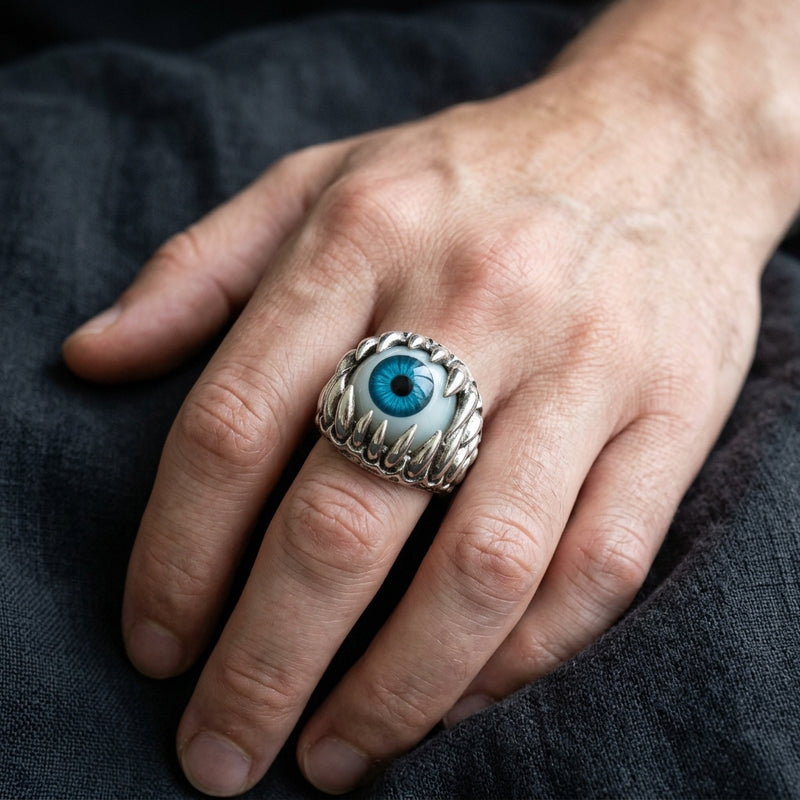
Blauwe oogbol klauwring van .925 sterling zilver
A round, domed eyeball gripped by pointed silver claws. The listing confirms .925 sterling silver but not the eyeball’s center material, so ask if that matters to you.
View claw ring details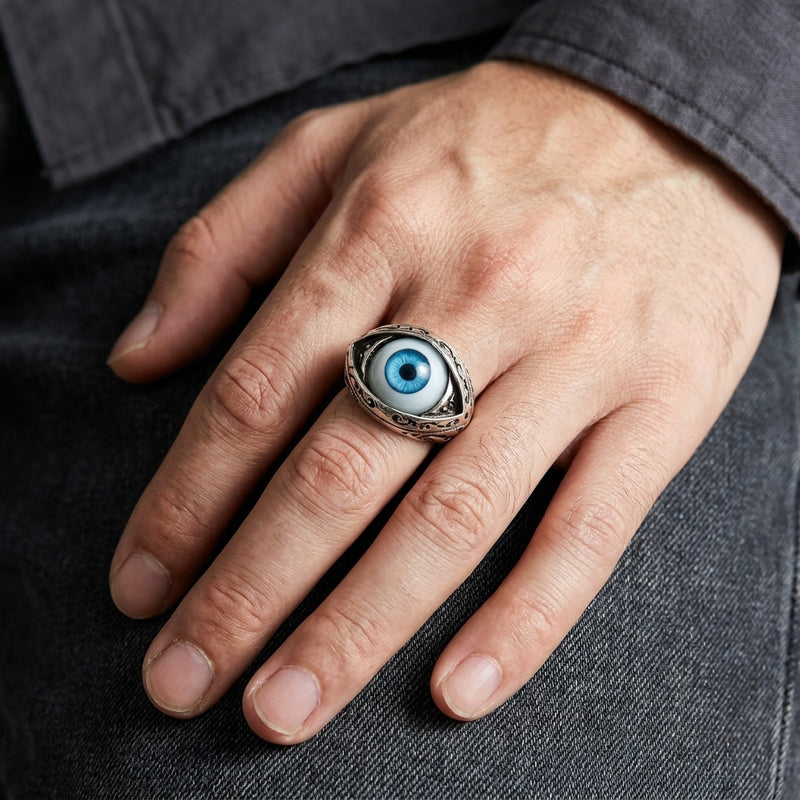
Blauwe evil-eye-statementring van 925 sterlingzilver
An almond-framed eye with oxidized filigree recesses and a listed blue glass cabochon center in .925 sterling silver.
View glass-eye ring detailsChoose the look, the association and the facts
Start with the look you want: a round eyeball held by claws, or an almond eye framed by filigree. If an amuletic association matters to you, consider the tradition or personal reason you want the piece to refer to; a retail title alone cannot supply that context. Then confirm the practical details: the center material, your US ring size and the stated face dimensions. A design you enjoy and a meaning you choose can coexist without turning either into a claim of proven protection.
When you are ready to see these alongside other designs, browse the full gothic rings collection.

