

A ring can look mechanical without having moving parts. Gothicrock lists the Tri-Metal Sterling Silver Steampunk Skull Ring with fixed gears, goggles and pipe details. The Iron Cross Sterling Silver Spinner Ring has a cross-patterned outer band that rotates around a stationary inner ring. If you want motion, check which component the description says moves before choosing by the style name.
That doesn't make steampunk and spinner rings opposites. "Steampunk" names a look, and "spinner" names a mechanism. A ring can have both, one, or neither, so the reliable approach is to read how each ring is actually built.
The style name versus the moving part
Two terms do most of the work here.
Relief is raised decoration. On the skull ring, gears, goggles and pipe shapes form a sculpted face, with darkened recesses separating the details from the polished metal. The mechanical imagery is part of a fixed design; it is not an operating set of gears.
On the Iron Cross spinner ring, the construction is different: an inner ring sits against the finger while a separate outer band turns around it. That outer band occupies the center between two smooth silver edges and carries the repeated cross pattern. Here, the decorated band is the part that rotates.
So the useful question isn't "Does it look mechanical?" It's "Which part moves, according to the listing?"
Two constructions, compared
Both designs use solid .925 sterling silver and darkened recesses; the skull ring also has copper and brass accents. Both have listed US finger sizes. Their construction answers a different preference: fixed sculpted detail or a rotating band. One caution about the numbers: the skull ring's measurement is its face (the decorated top), while the spinner's is its band width. They measure different parts of the ring, so you can't compare them directly. The weights are the seller's approximate figures for each whole ring.
On small screens, scroll across the comparison table.
| Check | Steampunk skull ring | Iron Cross spinner ring |
|---|---|---|
| Which part moves | The mechanical details are fixed relief; no moving component is described. | The outer band with raised Iron Cross motifs rotates around a stationary inner ring. |
| Actual materials | Solid .925 sterling silver base with copper and brass accents | Solid .925 sterling silver; 925 stamp inside |
| Stated measurement | Face approx. 28 × 32 mm (face dimensions, not band width) | Band width approx. 14 mm |
| Approximate item weight | About 32 g, whole ring | About 19 g, whole ring |
| Finger size selection | Set US sizes; not adjustable | Set US sizes |
The listing describes the skull ring's copper and brass details as a group. It doesn't say which gear or goggle is which metal, so we don't either. If you want to know how those metal colors work with the rest of an outfit, our guide to mixing metal tones with a dark outfit covers that.
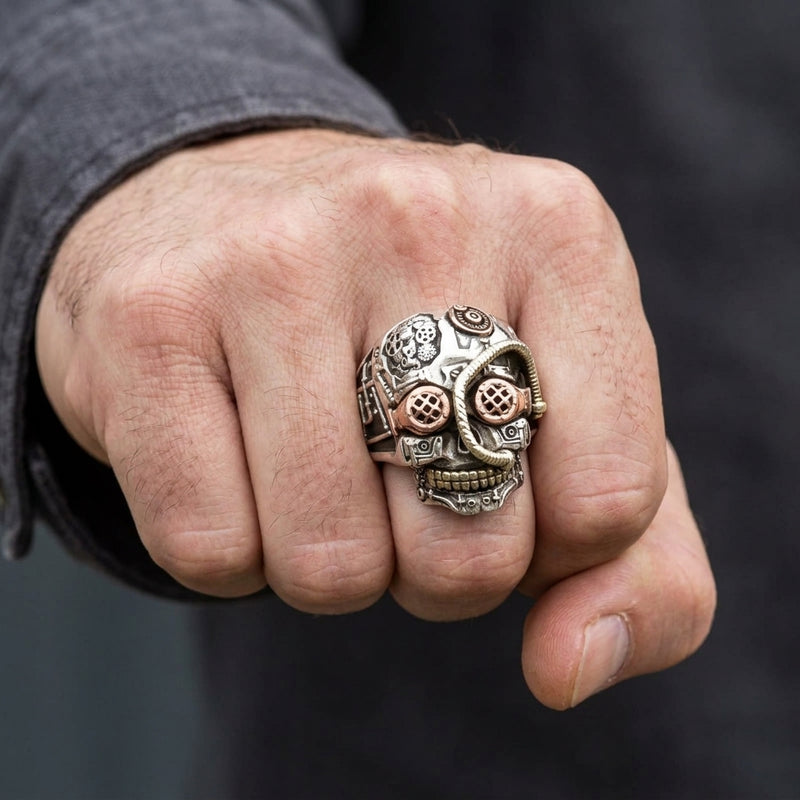
Tri-Metal Sterling Silver Steampunk Skull Ring
The skull, gears, goggles and pipe details are fixed raised relief on a sterling silver base with copper and brass accents.
View details and sizes
Iron Cross Sterling Silver Spinner Ring
Raised Iron Cross motifs sit on an outer band that rotates around a stationary inner ring.
View details and sizesWhen to choose each
Choose the fixed skull design if the sculpted face is your priority: the goggles, gears and pipe form one composition rather than a separately turning band. Its listed face dimensions help you judge the amount of decorated space, while the approximate whole-ring weight is higher than the spinner's. Those figures describe the product; they do not establish how either ring will feel on your hand.
Choose a spinner when you want the movement itself. The choice centers on a band you can turn while the inner ring stays in place. On the Iron Cross ring, the repeated cross motif sits on the rotating band between two smooth edges, so the pattern moves when the band does.
Ask yourself one question: when you look at your hand, do you want to see a detailed scene, or do you want something to turn? Fixed relief gives you the first. For the second, gear imagery won't help, and only a rotating part will. If you want both, look for a listing that describes a steampunk design on a rotating band, and confirm the construction the same way.

Before you order
- Find the moving part by name. Look for wording like "rotating outer band" or "spinner." If a listing mentions gears but says nothing about rotation, treat the gears as decorative unless the seller says otherwise.
- Don't treat a photo as proof of motion. A still image shows how a ring looks, not whether any part turns. If movement is what will decide your purchase, ask the shop whether there's a video of the actual product before you order.
- Know what the listing doesn't cover. The spinner's listing doesn't say how freely the band turns, how much resistance it has, or whether it makes any sound. If spin feel matters to you, ask about it directly.
- Choose from the listed finger sizes. Both rings come in set US sizes, so pick your actual size. Face size and band width are separate from finger size. For how face, width and profile change a ring's look, see our guide to gothic ring styles.
- Keep care simple. For the skull ring, the listing recommends a soft dry cloth. Chemical dips can change the copper and brass accents and the darkened contrast.
Next step
Once you know whether you want detail that stays put or a band that turns, browse the gothic rings collection. In each listing, check which part moves and which doesn't.

