

Goth and punk accessories draw on a lot of the same raw material: sterling silver, skulls, crosses, studs, zips and other decorative hardware. None of those pieces classifies the person wearing them.
If you are comparing goth vs punk accessories, a checklist of which jewelry belongs to which scene is less useful than looking at how each detail is composed with the rest of the outfit. A single ring can read differently depending on the sleeve, the metal around it and where the fabric stops.
The two arrangements below use one ring to explore three choices: the sleeve’s edge, its metal details and the space between cuff and ring. Treat them as styling illustrations, then vary one detail at a time in your own outfit.
A shared vocabulary with a wide cultural range
Goth rock emerged from British post-punk in the late 1970s. That musical context matters when discussing the scenes, but it does not make a ring or a jacket a reliable way to classify a person.
Museum exhibitions have also shown how wide each scene is. The Met's 2013 exhibition PUNK: Chaos to Couture examined punk's influence on high fashion. It placed do-it-yourself making beside couture and organized its material into themes that included hardware, bricolage, graffiti and agitprop, and destroy.
The Museum at FIT's 2008–09 exhibition Gothic: Dark Glamour presented many gothic approaches, including old-school goth, Victorian-inspired, industrial and cyber-goth styles, alongside work by fashion designers.
These exhibitions offer context for the range of approaches. The modern rings below are styling examples; their appearance alone cannot tell you a wearer’s musical tastes or personal beliefs.
An annotated comparison: one ring, three changes
The cover pairs the same Punk Not Dead skull ring, with the same hand pose at roughly the same scale, against two different sleeves. On the left is a soft black ruffled cuff. On the right is a straight black denim cuff with a zip. No other jewelry appears in either panel.
For convenience, we call the left arrangement ornamental and the right arrangement hardware-focused. Those labels describe these two compositions only. They are not definitions of goth or punk people.
- Edge shape. The ruffle gives the ring a curved, layered border, while the denim hem gives it one straight line. Look at the ring’s oval rim beside the ruffle’s curved folds, then beside the denim seams and zip. Which lines do you want the eye to follow?
- Repeated garment hardware. The zip teeth and round rivets on the denim cuff add repeated metal details near the silver ring. The ruffled cuff carries no hardware, which leaves the ring as the only metal in that panel.
- Placement relative to the cuff. Both cuffs in the cover stop near the wrist, leaving a visible gap before the ring. For a separate variation, move your own sleeve farther up the arm, then let it return toward the hand. Compare the gap while keeping the ring in place.
You can try the same exercise with your own clothes. Keep the ring and hand position the same, then change only one of these three details. When a single detail changes, it is easier to see what that detail contributes. This is an editorial observation from styling, not a tested result. Lighting, cameras and viewing distance will all affect what stands out.
| Change | What to compare | What it cannot establish |
|---|---|---|
| Edge shape | Try a curved or ruffled edge, then a straight hem, near the same ring. Compare the curved outline with the direction of the seam. | The wearer's scene, music taste or identity, or whether one style is more correct. |
| Repeated garment hardware | Try a cuff with a zip, rivet or buckle, then one without. Notice whether the ring seems to belong to a set of metal details. | That the repetition will be noticeable in every light, photo or viewing distance. |
| Placement relative to the cuff | Push the sleeve up, then let it fall toward the hand. Notice how the gap between fabric and ring changes. | How a ring fits, feels or wears on your hand over a day. |
Mixing the ingredients instead of choosing a side

The second scene combines both treatments: a ruffled black blouse under a black denim jacket, with a visible cuff zip and round metal details beside the Star Cross filigree ring.
Here the ring's curved, darkened scrolls sit near the ruffle's soft edge, while its polished silver edges sit near the zip. One ring connects to both garments without belonging to either category.
You do not need separate goth and punk purchases to try this. Hardware you already own, such as a zip, buckle or jacket rivets, can sit beside ornamental pieces such as filigree or lettering. It works in reverse too: a skull with raised lettering can sit against a ruffle, and a filigree cross can sit beside a zip.
Change one layer or one sleeve at a time, and notice which of the three changes you see first.
Two rings that carry different details
Both examples are .925 sterling silver and use motifs that turn up across both wardrobes. The listed dimensions describe different parts of each ring, so they are not a like-for-like size comparison. For sizing, see each product page.
Punk Not Dead Skull Sterling Silver Ring
Raised lettering around the rim surrounds a skull with a small clear stone on the forehead, dark eye sockets, a textured oval background and tapered shoulders. The skull is listed at 3/4 × 1 inch (about 19.1 × 25.4 mm). The ring weighs 19 g and has 925 stamped inside the band. The lettering is part of the design and says nothing fixed about a wearer's views.
Star Cross Filigree Sterling Silver Gothic Ring
A raised angular cross with an engraved star at its center sits over openwork filigree, with polished edges and darkened scrolls. The face is listed at 0.9 × 1.1 inches (about 22.9 × 27.9 mm), with an approximate weight of 18 g, a .925 hallmark and selectable US sizes.
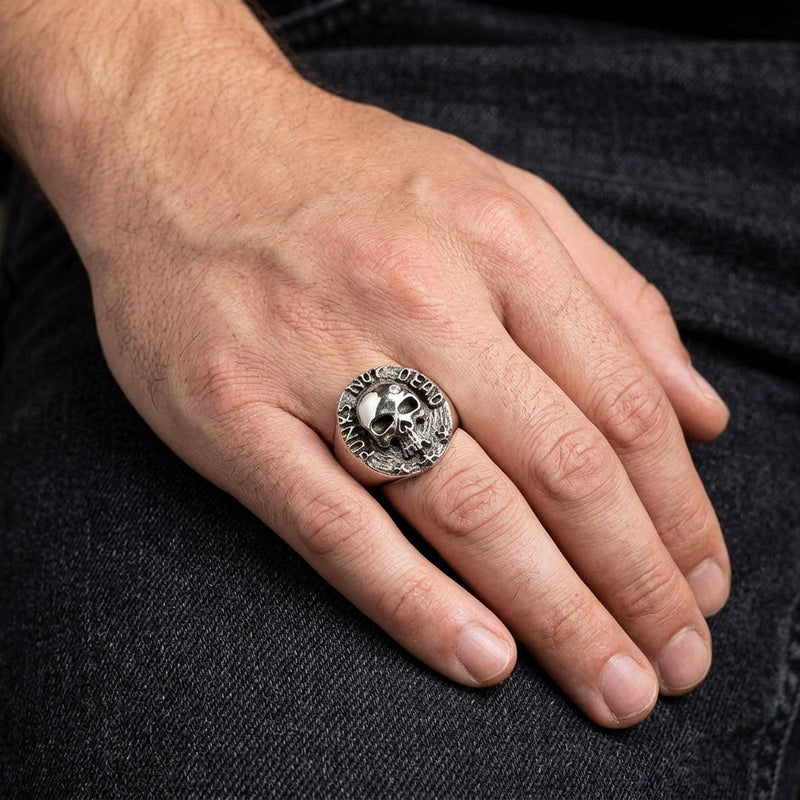
Punk Not Dead Skull Sterling Silver Ring
An oval skull-and-lettering face to compare beside curved cuff folds or straight denim seams.
View details and sizes
Star Cross Filigree Sterling Silver Gothic Ring
Its curved filigree scrolls and polished edges let you see how one ring can connect a ruffled edge with nearby zip hardware.
View details and sizesWhere to go next
Before buying anything, try the three changes with jewelry and garments you already own. One sleeve and one ring are enough to start.
For motif types, sizing and care, compare ring shapes and specifications in our separate guide. If you would rather browse, the gothic rings collection brings more designs together in one place.

